

...he got robbed. Starring Karl Malden. Also starring Michael Douglas - in COLOR. Granted, Buster Posey is everything and a can of corn, even though folks in San Fran think it's better to give your kids pot brownies than canned veggies.
A Quinn Martin production.
Tonight's guest stars:
- Buster
- Jason Heyward
- Gaby Sanchez
- A bean sprout pattie with soy cheese on a gluten-free bun
- Barry Bonds' head
- and June Foray as Tallulah Bunkhead.
Tonight's episode; Rookie..of the FEAR
Buster (there's just something about that name) is far from a bad choice for National League Rookie of the Year, which he won yesterday. He had an excellent season with the bat, a pretty good one behind the plate and, most importantly, he kept my fantasy team competitive until the last week of the season. But the facts as dug up by Karl Malden's nose show that Mr. Heyward had a better season and was more important to his team than Buster, even if only slightly.
Mr. Heyward played 142 games for the ATL and started 136. Buster started in 105 games, giving Mr. Heyward 180 more plate appearances. It is true that Buster hit better than Mr. Heyward. Oh wait, he didn't; Heyward's park-adjusted OPS+ was 131, Buster's 129. I bet Buster never leaves home without Mr. Malden's American Express traveller's cheques, which of course gives him an edge.
Okay, but if Buster hadn't been there, the Giants wouldn't have made the playoffs. That may be true as Buster had a WAR (Wins Above Replacement player, Baseball-Reference.com version) of 3.0, and if the Giants had lost two more games, they would have stayed home. So that puts him ahead of Mr..... - oh, hold it, it doesn't. Mr. Heyward's WAR was 4.4. True, the higher WAR is helped a little by Heyward's playing time advantage, but if the argument holds true for Buster, it holds true for Heyward - he was the Braves' Big Mac. Speaking of Big Macs, here's a word from our.....hey, isn't that J. J. Evans' dad? Dynomite!
It is true that Buster played a more important position; catcher. It is also true that Buster played that more important position for just 75 games. Granted, he was good those 75 games, but that was clearly due to his bat, not his mitt. Mr. Heyward, on the other hand, was an excellent defensive right fielder. In the end-of-season awards handed out by John Dewan's outstanding Fielding Bible, the real fielding awards (as opposed to the Gold Gloves, which are made with polysorbate 80 and high fructose corn syrup), Heyward finished 3rd in voting among all right fielders. Buster finished 10th among catchers. Ahhh, butter. Parkay!
What happened to Mr. Heyward is that he was a victim of - and I think someone got ripped a new one for warning of this ...maybe it was Kojak - his Spring Training hype. When he started hitting 600 foot bombs using only Chipper Jones' artificial leg, even the reserved Bobby Cox told the world that Mr. Heyward was The Lord, Muhammed, and Beastie Boy Mike D. combined. When he was one of the best players in the National League the first two months of the season, the media had no doubt he would hit 50 homers, overtake Lebron James for the NBA scoring lead and overtake Paris Hilton for the world scoring title. But the only baseball player who never slumped was Barry Bonds earlier this decade, and that only lasted until the day his gigantic head fell off and fatally crushed Dusty Baker's young son. And Mr. Heyward slumped badly in June. Then, he got hurt.
He played well the rest of the year, but Mr. Heyward finished the season with exactly as many homers as did Buster. Even though his other numbers were better than Buster's, the media voters expected Mr. Heyward to do nothing but give them thrill-up-the-leg moments such as his season-opening homer all season long. When he didn't, their "Dear John" letter to him was to give his award to Buster. Either that or they think Buster has a cute butt when he squats. It wouldn't be the first time. How do you think Derek Jeter has won five Gold Gloves from the managers? If anyone knows rear ends, it's a baseball manager. I hear they feel a lot like rich, Corinthian leather.
Buster had a very good season and, barring injury, should be an excellent player for a long time. His Rookie of the Year award certainly isn't the worst one ever given. He just didn't deserve it over Heyward. Now, freeze shot...throw your head back and give me a Sammy Davis, Jr. fake laugh. Hold it! Now, closing credits.
Tuesday, November 16, 2010

Thursday, November 11, 2010
Atomic Dan

(published in the News-Item of Shamokin, PA, November 11, 2010)
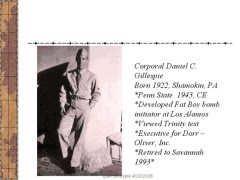
As he saw history's very first nuclear explosion - religiously code-named "Trinity" - spread across the barely sunlit New Mexico skyline, Dan Gillespie admits his first thought perhaps didn't measure up to the magnitude of the blast. "Well, thank God it went off," was all that came to his mind. Almost immediately afterward, his feelings turned more introspective, closer to those of his Manhattan Project boss, J. Robert Oppenheimer: "I then thought, 'What have we done?'"
Today, Alzheimer's disease slowly robs the 88-year-old Shamokin native of his memory, but it doesn't take away any regrets Gillespie may have had for helping to develop the atomic bomb. He never had any to begin with.
"We knew than the impending invasion of Japan would cost a million American lives," Gillespie says from Skidaway Island in Savannah, Ga., the city Gillespie has called home since 1993. "We also knew that Germany and Japan were working on a bomb. We were way ahead of them as it turned out, but we didn't know that at the time."Valedictorian at SHS
Gillespie didn't know he would be working on the bomb, either. After graduating as valedictorian of Shamokin High School's Class of 1939, he initially received deferments from the draft when America entered the war as he pursued a chemical engineering degree from Penn State. Gillespie got his degree in 1943 and promptly received another deferment because he worked in what was considered an essential civilian industry. But the need for manpower grew, and Gillespie's number came up, landing him in Army basic training near Little Rock, Ark.
"They assigned me to an infantry unit, but I had also applied for OCS (officer candidate school) as well as ASTP (Army Specialized Training Program) based on my chemical engineering background," he said.
One day during his 14th week of training, a second lieutenant pulled Gillespie off a rifle line to tell him he had been accepted to both, and Gillespie made what turned out to be a historically important choice.
"I asked the officer what he would do, and he said he had decided to do ASTP first and then go to OCS, so I told him I'd do that, too."
Off to Los Alamos
After some training at Ohio State University, the Army sent Gillespie to what appeared to be a mountainous no-man's land; Los Alamos, New Mexico. Oppenheimer, often called the "father" of the atomic bomb, had scouted the mostly desolate area that formerly housed the Los Alamos Ranch School, a private boarding school whose alumni included writer Gore Vidal, an author and political activist. The federal government bought the land that would become the Los Alamos National Laboratory in 1942, consolidating nuclear work previously scattered across a number of universities.
Gillespie was told he would be designing an initiator, in essence the trigger to detonate an atomic bomb. In oh-by-the-way fashion, Gillespie was also told that he, all of 22-years-old with a degree but practically no real world chemical experience, would be the only scientist working on a particular type of initiator.
"I later learned they were using a 'shotgun' approach, with several scientists trying several types of initiators until they found one that worked," he said.
Gillespie's approach must have been OK - it was the one chosen for that first "Trinity" test explosion.
"I still have some of the Trinitite," Gillespie proudly says of the glass particles the explosion created from the desert sand.
Gillespie then helped design "Fat Man," the second and, thus far, last nuclear weapon used during war. The bomb named after the character in the novel and movie "The Maltese Falcon" was dropped on Nagasaki, Japan, on Aug. 9, 1945, three days after "Little Boy" was dropped on Hiroshima. Gillespie's work was done, as Japan surrendered soon afterward.
Still active at 88
After a career at Dorr-Oliver, a company that made equipment for separating solids from liquids, where he eventually became CEO, Gillespie retired to Savannah where, in 1950, he had met Juliet Yearns while on a business trip. They would remain married until her death in 2006. Not long after losing Juliet, Gillespie learned that occasional memory lapses he was experiencing were the early stages of Alzheimer's. It may have slowed him down a bit, but he hasn't let it stop him from living.
Gillespie sings tenor in the 13th Colony Sound, Savannah's men's barbershop chorus and doesn't have any problem remembering the words to songs. He also still has his wit; during one of the chorus's stage shows, amidst the frenetic back-stage bustle, Gillespie remarked "building initiators was easier than this."
He also enjoys hot wings from Spanky's, the chorus's local hangout, making him the envy of other older gentlemen whose stomachs can no longer tolerate spicy food.
Telling his story
Most importantly, Gillespie wants to tell the story of the World War II generation to as many young people as he can while his memory allows him to do so. "Fortunately, I remember what happened back then better than I remember what happened yesterday," he said. His dedication to preserving that era stems from a talk he gave to a high school history class taught by his son, David, in Poolesville, Md. "I asked if anyone had any questions, and the first question was from a young lady who asked 'What does WWII stand for?' I thought, my God, we're in trouble if the young people don't even know that." His son helped him make a PowerPoint presentation of the story of his time at Los Alamos to help him deliver speeches.
'He's my hero'
Gillespie also beams whenever he shows off one of his most prized possessions, a letter of recommendation from Oppenheimer himself. "Your diligent work during the most trying times and under the difficult and dangerous conditions that the urgency of the work required was an important factor in bringing success to the project," Oppenheimer wrote. Bob Kearns, the president of the 13th Colony Sound and Gillespie's close friend, describes him in more simple terms, "He's my hero."
Gillespie likes to say that he was proud to have "made a contribution." What he did was take his small town central Pennsylvania smarts and use them to help save the world. Some contribution, indeed.
(Many thanks to News-Item editor Andy Heintzelman for helping to tell Dan's story.)
Monday, October 11, 2010
Sorry, Brooks. You're a Better Man than I am
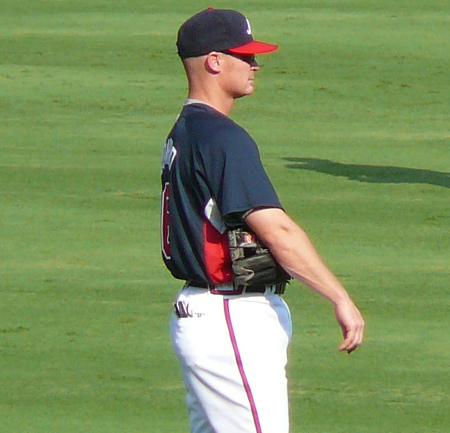 When it comes to Brooks Conrad, I did it, too, just like many Atlanta Braves fans. I asked, rhetorically, why the heck is he named 'Brooks', because he plays like Foster Brooks? I don't think I went as far as the person who commented on one of the Braves' fan pages - something akin to "F*** that mother f****** piece of ****, ********ing **************." But I was close, as in suggesting his name should join the list of words and phrases banned from my household, like racial epithets, Hannah Montana and "I'd like my steak well-done." A few hours later, I realized that Mr. Conrad is much more of a man than I am.
If you aren't following baseball's playoffs, Brooks Conrad committed all three Atlanta errors last night, including one that allowed the winning run to be scored with two-out in the top of the ninth, in the San Francisco Giants 3-2 win. Their best-of-five series isn't over, but Atlanta is in a two-games-to-one hole. Mr. Conrad has committed eight errors in his last seven games, some at third base, some - like last night- at second. Why is Mr. Conrad still playing virtually every day, you ask? Because the Braves' roster has fewer healthy people than a tuberculosis ward. Chipper Jones had his usual "I've broken everything but my schwanzstucker" season and has long been gone, and all-star second baseman Martin Prado was lost for the year in late September with a hip pointer - the very painful injury, not the activity of politicians reaching for your hip because they assume your wallet is there.
Mr. Conrad was also in the game because until the last two weeks, his was the - in the parlance of happy movie voiceover guy Mark Elliot - "the Summer story of a lifetime, featuring all your favorite Disney characters." He labored for six years in the Houston Astros minor league system and was released, never getting the chance to play for the big club in the city that's uglier than a bowling shoe. In 2008, Conrad did get a chance to play for a major league club in a city only slightly less ugly, Oakland, before being signed into the Braves' system in 2009. After a handful of appearances in Atlanta last year, Conrad made the 2010 Braves' roster as a 30-year-old rookie during Spring Training. He would mostly sit on the bench, not a glamorous role, but certainly not a bad way to make a $400,000 salary, and most of us schmucks who today are invoking Conrad's name while making familial sexual references would give a testicle to ride the major league pine.
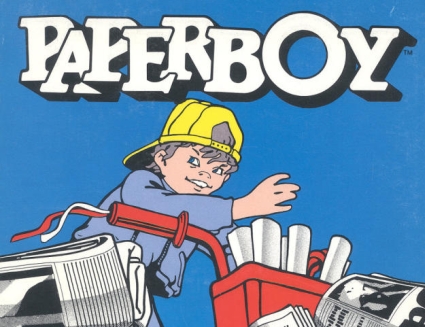
Mr. Conrad made the most of his opportunity. Of his eight home runs during the season, three were as a pinch hitter, and two of those pinch-homers were grand slams. He is the only rookie to hit two pinch-grand slams in one season...the only one ever, in 134 years of official Major League Baseball and the five or so tobacco-stained mustachioed years of big-league ball prior to the National League's birth in 1876. Mr. Conrad surpassed everyone's expectations, so while there was some trepidation when he was pressed into everyday duty upon the decline of Mr. Prado's ability to mambo, there wasn't overwhelming worry among most Braves fans. That's when Mr. Conrad began throwing baseballs as if he were trying to break 18 windows in the home of a non-subscriber in the greatest video game of the 1980's, Paperboy.
As evidenced by the venom spewing forth from our fangs, that still didn't prepare Braves' fans for what happened last night. Still, shame on the historically fair-weather Atlanta fans for booing Brooks every time his face was shown. Shoot, they were booing the guy before the game started because of his errors prior to last night. They even booed the pre-game highlight video showing his pinch-hit grand slams. Classy stuff, especially since the guy they should have been booing is their soon-to-be-retired Hall of Fame manager, who made the same mistake that Red Sox manager John McNamara made in the Bill Buckner 1986 World Series.
Since Mr. Conrad had made two errors already, one of which led to the Giants first run, why didn't Bobby Cox insert a defensive replacement in the ninth inning? Even with the Project Runway supermodel-thin bench, there were options available. Now, many have argued that this is typical Bobby Cox, the man who supposedly doesn't know how to manage even though only three other managers in history have won more games. But every manager, Hall of Famers included, make just as many mistakes and have their own reasons for what, in the hindsight of us Einsteins, appear to be ridiculous decisions. Still, Mr. Cox flubbed this one and should have admitted as such after the game. Mr. Conrad, meanwhile, took his medicine like a man. "I wish I could just dig a hole and sleep in it," is how he succinctly put it. If only all of us who were, and are, trashing Mr. Conrad so manly.
Tonight, when the pre-game highlight video of his pinch-grand slam is played, the slam that capped an incredible seven-run ninth-inning rally to beat the Reds on May 20, Brooks Conrad will be booed. If he plays in Game 4 of the series, which is doubtful at this point, he will be booed more loudly. Bobby Cox will not be booed for his blunder, nor will the Braves hitters, who are batting a robust .165 in the series. Fair or unfair, Brooks Conrad stands to be goat for the rest of his life. He should be hero, not just for making the majors after nine years of minor league toil, but for setting an example of taking blame for your mistakes, even when they aren't entirely your fault. Sorry, Brooks. I should have known that from the get go instead of acting like all the other jerks.
Monday, September 13, 2010
Shaun Tirrell vs. Mike Manhattan; Sorry, Mike, but you lose
 Mike Manhattan, newsman for Savannah's number one TV station, is by all accounts a fine person. He is to be greatly admired for his thus far successful personal battle with cancer, and his voice is of the quality that make women swoon and make men wish for a little additional testicular fortitude. But as a sales pitchman, Mike Manhattan could have partnered with the island of Manhattan and still have been decimated this past Saturday by a fast talking and faster playing piano man who claimed to be a poor salesman.
Mr. Manhattan was emcee for the Savannah Philharmonic's "The American Spirit" September 11th show at the eternally gorgeous, if slightly toasty warm, Lucas Theater. Part of Mike's job was to ask people to support the organization built from scratch by conductor and music director Peter Shannon in ways other than buying tickets to shows; the good old membership drive well known to fans of public radio and TV. In fact, Mr. Manhattan's appearances began to resemble those infamous pledge breaks - his third trip out elicited a whisper of "Lord! Him again?" from a patron seated behind me and my wife.
Mike's intentions were, nonetheless, noble, and there was nothing incorrect about what he said. If we don't support this orchestra, Savannah won't have the music Mike very accurately described as beautiful, exquisite, effervescent, pulchritudinous (okay, he didn't use that one, but dang, with his voice, that would have sounded marvelous). Mr. Manhattan made the requisite request to check out the table in the lobby during intermission or after the concert to inquire about becoming a member and all the benefits of membership, though unlike public TV, membership doesn't get you Dr. Wayne Dyer's latest book "How Bald Gurus Make A Killing Off This Shtick."
Then, during the second half of the show, a man whom some Savannah Philharmonic fans saw at a show last year appeared on stage. Concert pianist Shaun Tirrell, having waived his usual fee to perform, played the bejesus out of the third movement of the Concerto In F, one of George Gershwin's least appreciated compositions among the general public. Tirrell, with a multitude of awards and honors that only the serious music fan knows or cares about, was amazing, not to mention Maestro Shannon and the accompanying orchestra. Almost as stunning was the brief speech and, as it turned out, sales pitch Mr. Tirrell made afterward.
With an 'aw, shucks' attitude more in tune with Johnny Mercer's Savannah than Mr. Tirrell's home of Gaithersburg, Maryland, he made a pitch to support the Savannah Philharmonic that was by far the most effective of the evening. Well, as if Mr. Tirrell's playing wasn't an effective enough pitch, Shaun told us that Peter Shannon was the finest conductor he had played for. Not "a pretty good conductor", not "one of the finest", not "a bloody good musician and a fine consumer of the fruit of the vine", THE finest conductor. You don't have to be a calculus expert to know how many conductors Mr. Tirrell has probably played for.
Even more telling was that Mr. Tirrell missed his son's birthday, which was the day before the show, for the chance to play with the Savannah Philharmonic. That made me want to immediately whip out the check book and join the Philharmonic's "Conductor's Circle", which gets you great tickets to the shows, your name in the concert programs, and car washes for life from the percussion section (I think). Since that check would have been more rubberized than a Goodyear plant, I didn't.
Still, I'd like to think that an endorsement from the likes of Shaun Tirrell would make folks realize that we don't have to wait for the Savannah Music Festival every year to see world class musicians. We already have them here, and helping them put on several shows in a season doesn't really cost you as much as tickets to one Music Festival show.
Mr. Tirrell ended his pitch by talking about his grandfather and how he had introduced him to the music he loved. His 'Pop' was a salesman by trade, Shaun said, an excellent one despite his eighth-grade education, and Mr. Tirrell claimed he could never sell anything as well. Mr. Tirrell was wrong. In my book, he outsold not only his Pop but also Mike Manhattan, who was there in part to specifically sell the Savannah Philharmonic. No offense, Mr. Manhattan, but Mr. Tirrell had me with the first note he played. Let's hope he had most everyone else there by the time he left the stage.
Thursday, September 9, 2010
How a Skylark And a (Mr.) B Broke Down a Barrier
 When Bix Beiderbecke, who made more beautiful sounds emanate from brass instruments than perhaps any other human, died at 28 from an overdose of degenerate behavior, no one would have guessed that his passing would eventually help tear down a wall of musical racial separation. Even more unlikely was that help in bringing down that wall came from a guy from segregated Savannah, Georgia and a guy from Indiana, home of the modern Ku Klux Klan, or that the voice which blasted the wall away had bi-racial grandparents native to the bigoted nation's capitol.
Bix, self-taught cornet king back when most everyone could distinguish the mellow cornet from louder cousin trumpet, was the idol of many musicians in the 1920's. One idol who got the chance to play alongside Bix was young Hoagy Carmichael, recent graduate of his hometown Indiana University law school. No matter how badly Bix treated himself - the human body was not designed to consume even half of the notoriously nasty Prohibition bootleg gin Bix supposedly ingested - Hoagy was naturally enthralled by the chance to play alongside God. He was so hooked that two of Mr. Carmichael's prized possessions had some Bix in them; Hoagy's first child, a son (luckily) named Hoagy Bix, and a cornet mouthpiece that once belonged to the king himself. The mouthpiece was a mainstay of Hoagy's suit pocket until Mr. Carmichael passed it on to a lyricist, a younger fan of Bix with whom Hoagy occasionally worked - John Herndon Mercer.
Between the first time he worked with Johnny in 1933 and when they would come together again around 1940, Mr. Carmichael wrote some melodies based on Bix's solos - or perhaps they were actual Bix solos as eminent jazz biographer Gene Lees once suggested - in hopes of making a Broadway musical about Bix. When it didn't happen, Hoagy gave one of the melodies to Mr. Mercer to write a lyric for it. It only took John almost a year. Mr. Mercer, sometimes ready with a lyric in as little as half-an-hour, struggled with the melody so much that Hoagy later claimed he had forgotten about it when, one day out of the blue, Mercer presented him with "Skylark."
It was kind of a big deal, big enough to be on the Billboard pop charts four times under four different artists....in 1942 alone, with three of those in one month! Glenn Miller (with Ray Eberle on vocals), Harry James (w/Helen Forrest), and Dinah Shore were all on the same Billboard chart with the exact same song in May of '42. Bing Crosby (of course) would have a hit with it two months later. But before fans bought copies of those records, something happened with "Skylark" that perhaps had never before occurred; it's inaugural to the white entertainment world over the radio was given by black artists, among them Billy Eckstine.
Mr. B., he of the mixed-race background, began singing with the man many consider the first modern jazz pianist, Earl "Fatha" Hines, in 1939. By then, Hines and his orchestra were household names among white and black audiences thanks to an eleven-year run as "the most broadcast band in America" from their home base, the Grand Terrace Ballroom of the Al Capone-controlled Sunset Cafe in Chicago. It was no longer the Grand Terrace Orchestra after 1940; Hines thought he was underpaid and could say so aloud without fear of bullets now that Capone was long gone. Still, the Hines band could easily get a radio gig, and during one particular gig on the air in '42, they appear to have been the first band to play the latest Carmichael/Mercer tune into the ether, likely the first time a black singer and band debuted a mainstream (meaning white) pop song on the radio.
It isn't known whether a recording of that radio performance exists, but the Hines band's studio recording of "Skylark" was just as "sweet" and had just as much of a pop feel as the Glenn Miller version. As Mr. Eckstine crooned the lyric, he was even accompanied by an apparent "skylark", a very un-Hines-like flute for crying out loud, half a decade before flute tweets helped carry Nat King Cole through "Nature Boy." The mellow sax solo during the bridge wasn't as jazzy as Harry James's treatment of the "Skylark" melody with his muted trumpet. In other words, it wasn't exactly the best version of the song. But it was solid, and it helped cement Mr. B. as the "Sepia Sinatra", a ridiculous racial moniker common to the era no doubt. There is also no doubt that a lot of women began swooning to Billy Eckstine during the war.
Hines and Eckstine's recording of "Skylark" didn't sell as well as those of their white contemporaries - their big hit song of '42 was their own composition "Stormy Monday Blues", number one on Billboard's new Harlem Hit Parade, the non-P.C. precursor to the R&B chart. But Fatha and Mr. B. proved to Johnny Mercer, Hoagy Carmichael, and other songwriters that you didn't need Bing Crosby, Benny Goodman, or other performers of pallor premiere your song on the radio to grab an audience's attention. Nat Cole is remembered by most as the first black pop singer with mass appeal among white and black fans. Record sales numbers these days may reflect that, but I think Nat himself would remind us that Billy Eckstine beat him by a few years, with some help from Mr. Mercer and Mr. Carmichael and Mr. Bix.
Monday, August 30, 2010
Mr. B

The first time I heard the voice of Billy Eckstine, Billy Eckstine wasn't even doing the singing. In 2003, I learned that my "intimate" knowledge of singers and songs from a bygone era, of the Great American Songbook and it's greatest performers, turned out to be about as intimate as Bill and Hillary Clinton. That was the year my wife purchased for me a Rat Pack DVD, which I knew I would enjoy immensely. I wasn't expecting to be introduced to one of the most gorgeous voices in the world.
The DVD was "Live And Swingin'" and featured a 1965 St. Louis performance of the Rat Pack, minus the by-then excommunicated Peter Lawford. A standard part of Sammy Davis, Jr.'s shtick from his earliest days as a performer was impressions of other singers, and one of his regular impressions was Billy Eckstine. Davis, exaggerating Mr. Eckstine's brilliant elocution, crooned the alternate lyric to the original Johnny Mercer line in "One For My Baby (One For The Road)", "Eyyyyyyeeee could telllll you a-lllot, but you've got to be, trooo-ooo--ewwwwww to your coooo-ewwwwwd, soo-ewwwww make it one for myyeeee bway-bweeeeeeee...." It was funny, but I wasn't exactly sure why. After all, who the heck was Billy Eckstine?
A short time after watching the DVD, I got a more proper introduction to the man I later learned was nicknamed "Mr. B." in another unusual forum, one of cable television's Music Choice channels. This particular channel played standards, traditional pop songs and their singers; Sinatra, Nat King Cole, Andy Williams and others. I turned it on one night in an effort to get my daughter, two-years-old at the time, to go to sleep, figuring it would help since I had sung many of those songs to her since the day she was born. The second song we heard that evening was Billy Eckstine's cover of "I Apologize." Immediately, I got Sammy Davis's joke. The lyric was pronounced with the precision of a heart surgeon, some of the vowels large enough for a dozen baby grands ("Eyyy-eee a-paaaawwwhllll-oh-gi-eeeeezz), but Mr. Eckstine's voice knocked me out. The richness and depth of his tone were akin to that of an opera star, yet his voice was warm, playful, and seductive.
There wasn't much thought given to Billy Eckstine for a while after that except during repeated viewings of the Rat Packers - our little girl found them much more enthralling than kiddie super group The Wiggles, and who can blame her? One day, while the toddler was thrilling her mother by repeating one of Dean Martin's drinking jokes, I decided for no other reason than the hell of it to do some research. That is, I decided to Google Mr. Eckstine - what passes for research these days. I was flabbergasted. Billy Eckstine was at least as popular with music fans as Sinatra and Bing Crosby from the mid-1940's through the early 50's. I also learned that Mr. B. was a black man - some called him the "Sepia Sinatra", derogatory without being derogatory I suppose. That makes his popularity astonishing considering that era of our racial history. In fact, women of all colors stopped swooning to Sinatra in the late 40's in part because they started swooning to Billy, scandalous indeed.
Later still, I discovered that Mr. B. was also a bandleader, and though its time was short, it may have contained the greatest assemblage of jazz talent of any full-time orchestra. Dizzy Gillespie, Charlie Parker, and Miles Davis were in Mr. B.'s band at various times. So were Dexter Gordon, Fats Navarro, Gene Ammons and Art Blakey, not as well know as Diz, Bird, and Miles but just as talented. In the vernacular of the time, Billy's "girl singer" was a young Sarah Vaughn. And, of course, fronting the orchestra was Mr. B.'s golden voice, selling millions of ballads in between the band's ground breaking be-bop tunes.
Just last week, while (shameless plug warning!) hosting the "Johnny Mercer Hit Parade" on STAR 1400 (AM) and star1400.com, I discovered that the song containing one of Mr. Mercer's most beautiful lyrics, "Skylark", was premiered on the radio by none other than Billy Eckstine, singing for the orchestra of jazz piano legend Earl "Fatha" Hines. Seemingly every time I turn around, something else Mr. B. did first or at least before a lot of other folks keeps finding it's way to me. I'd like to know more, but there's a problem.
These days on the so-called "Adult Standards" radio stations where you can still hear the voices The Chairman, Mr. Cole, even Perry Como for crying out loud, you never hear Billy Eckstine's baritone. When folks talk about the great jazz bands and the pioneers of American music, we hear much about Louis Armstrong and Duke Ellington, Count Basie and Artie Shaw, and a lot about the guys who were in Mr. B.'s band. Never do we hear about Mr. B. himself, even though for a time he was more popular than all those guys.
Did Billy Eckstine do something, or perhaps not do something, that caused everyone but ardent music historians to forget him? Why don't we remember this man, an African-American who was only supposed to sell what at the time were called "race records", but instead rivaled perhaps the two biggest white singing stars in the nation's history?
I'd love to find out.
Friday, July 30, 2010
My little girl, The Biscuit Nazi
 Whenever I think I have it bad, I am brought back to reality by a number of things. I have the most wonderful, most beautiful, most talented wife in the world who, for some reason, puts up with me. I have a house in the less-than-half completed Housing Bubble Burst Acres subdivision. And I have two gorgeous daughters, the two-year-old ham sammich and the seven-year-old Biscuit Nazi.
Making biscuits this morning reminded me you can't take the Biscuit Nazi out of the Biscuit Nazi, even as she gets older. When she was two, we first began making biscuits together based on a recipe from Alton Brown, just about the only person worth watching on Food Network any more. Given that she is mildly autistic, this means that Mr. Brown's biscuit recipe might as well have been etched in stone by the Lord long before He gave the Ten Commandments to Charlton Heston. Hell hath no fury like the Biscuit Nazi if you are out of baking powder and try to substitute some cream of tartar.
It took almost two years to convince BN that, if you happened to be out of buttermilk, you could use regular milk. No, BN said, Mr. Alton said BUTTERMILK, you MORON. The biscuits will get up and run out of the oven, out the door, shake their flaky booties at the neighbor's dog, then explode on contact with the asphalt of the street. It's a good thing that, when we first began making biscuits together, we didn't tell her that Mr. Alton did not use only shortening in his biscuits. He cuts both butter and shortening into his dry ingredients, which does taste better, but we were trying to avoid having to buy butter every other day during that time a few years ago when dairy was more expensive than beer. We might have brought about the return the Four Horsemen by now, which would really have pissed off Ric Flair and Knute Rockne.
We don't make biscuits quite as much anymore, but when we do, the Biscuit Nazi returns, albeit in a somewhat milder form. She isn't as anal about ingredients anymore. Instead, BN has to do everything by herself, measuring the ingredients, mixing them, kneading and rolling - everything except put them in the oven, which she still understands she can't do. It makes me wonder what she'd be like if I had been a fish monger; "you can't use that fillet knife on a MONK FISH. The Monk fish Mafia are gonna GET YOU!"
If this sounds like a pain, it isn't. I wouldn't change anything about BN, and not just because her anal retentiveness helps her make a damn good biscuit. Besides, she is now forever the Biscuit Nazi as christened by Mr. Alton himself in an autographed picture he sent to BN after I got the chance to tell him the story. I think Mr. Alton understands completely, being somewhat of a food Nazi himself. Now, off to the store. We're need baking powder and buttermilk, and I don't want to be eaten by the giant invisible cow monsters who attack the owners of inadequate ingredients.
Subscribe to:
Posts (Atom)